Wednesday, March 19, 2008

WILD, WILD, WEST


For today's post, I'm obviously writing about the western film genre because we have recently finished it. For the most part, the western has surpasssed my previous notions about the genre. I had always thought that westerns were long and boring with cowboys and Indians along the way. In fact, there is a lot more to these films; the western is somewhat like a hero-journey, kind of like The Odyssey. The main character is usually a man who is somewhat of a rebel with a cause, whether it be revenge or helping a damsel in distress. He is rugged and handsome, not baby-faced and young but experienced and brooding. As we learned in Clint Eastwood's Unforgiven, he can be a man past his prime somewhat unsure of exactly what he is doing. In John Ford's Stagecoach, John Wayne is the protagonist who is an anti-hero; he is going to jail yet he is good at heart and treats people with the respect that they deserve, rather than the respect that society has given them.
Along with the brooding hero, there is the timid man. This is portrayed by Mr. Peacock in Stagecoach and the novelist in Unforgiven. He is scared and adds comic relief with his scared actions and submissive ways. Along with the timid man, there is the prostitute (or sometimes prostitutes) with a heart of gold. She is pretty and kind, and she cares for others whether they be fellow prostitutes or another member of society. The prostitute is usually the opposite of what most people think a prostitute is like; she is relatable (in Stagecoach Dallas is kind and loving towards Miss Mallory and her baby) and looks out for others (the prostitutes band together in Unforgiven). The prostitute usually develops some kind of a relationship with the hero.
Now, if you are like me and how I used to think that the western was boring, you must rent a western film to prove yourself wrong. In this genre there is action from cowboys vs. cowboys to cowboys vs. Indians. There is love, sometimes between prostitutes and sometimes between each other (BROKEBACK MOUNTAIN!! Doesn't that count?!) There is even humor mixed in with a plot that usually centers around a looming fight.
So if you're unsure of what you want to watch on a Saturday night, go to your nearest Blockbusters and run towards the western genre!

Tuesday, March 11, 2008

With a name like Guillermo, how could you go wrong?


To say that Guillermo del Toro's masterpiece "Pan's Labyrinth" is near and dear to del Toro's heart might just be an understatement. Del Toro directed, wrote, and produced the Spanish film. Interested in the Spanish Civil War, "Pan's Labyrinth" was del Toro's second film (after "The Devil's Backbone") that was based around that setting. The film deals with a little girl, Ofelia, confronting her cold and fascist step-father, Captain Vidal. Along the way, Ofelia gets guidance from a mystical Faun who tells her that she is the princess of the moon and that she must complete tasks that involve mythology and fairy tale elements, to return to her rightful position as princess. "For me, fascism is a representation of the ultimate horror and it is, in this sense, an ideal concept through which to tell a fairy tale aimed at adults." Guillermo has said. And that's what he did; del Toro presented his harsh take on fascism, which was instilled by him when he was just a boy and Spaniards sought refuge in his homeland Mexico, by weaving in a central story that is very much a dark fairy tale. Del Toro admits that "(he) has been fascinated by fairy tales and the mechanics at work in them since (his) early childhood."
To create the fairy tale, del Toro wove in his knowledge of mythology by incorporating such creatures as fairies to help Ofelia on her journey to save herself from her evil step-father. Guillermo created such creatures as a Faun that acts as a satyr to guide Ofelia on her journey, a man eating monster that will truly give viewers nightmares, and even a large toad. With these whimsical elements, del Toro holds the viewer's attention. Even the backdrops to the scenes themselves are truly haunting, from the Spanish labyrinth to the woods in the back of Ofelia's house; del Toro has it all planned out, and it works in taking the audience's breaths away. Added with the very precise facts on the Spanish Civil War, del Toro creates a story both factual and out of this world, and he manages to do so without leaving the audience confused.
Guillermo del Toro's hallmarks in his movies are his use of children to convey his adult tales ("Pan's Labyrinth", "The Devil's Backbone"- set in a boy's orphanage), his fascination with fairy tales and mythology ("Pan's Labyrinth", "Cronos"- a story about vampires), and a strong sense of self ("Pan's" and "Devil's Backbone" deal with issues he has witnessed in real life). The fact that Guillermo has written these amazingly eccentric films only leaves many people with one choice- use him as the director and producer, just to get everything right! I truly believe the main reason why del Toro is also the director and producer is because he has created such a dazzling story on paper that no one could really create it the way it is supposed to be except for the man behind the original idea and the story line.

Friday, February 29, 2008

Y'know you inspired me, doing what you did, going off on your own like that.


Just thought that I would blog for a tiny bit about the movie I saw tonight with Samrina; it's called "Penelope" and it's about a girl (played by Christina Ricci) who is cursed with the nose of a pig. Yes, it may sound quite farfetched and unrealistic, but hey, this is the movies! Christina Ricci is joined by a swoon-worthy James McAvoy, hilarious Catherine O'Hara, and a spunky Reese Witherspoon.
Penelope's great, great (and a few more greats) grandfather had the family cursed when he didn't marry the girl he was supposed to. The curse says that the first girl born to the Wilhern family will be cursed with the face of a pig, and that only true love from the same social class can break it. Thus Penelope's mother (O'Hara) bring in many a suitor, only to have them run away in horror. Yes it does seem unrealistic, but considering it is a fairy tale, stay with me.
Enchanted are the makeup, costumes, and set pieces. Throughout the movie Penelope sports a beautiful purple coat that is unique in style with its long coat tails and purple color. In her room, which she spends many an hour in, there is a swing that she frequently uses. These little added misc-en-scene elements make "Penelope" even more whismsical.
As the movie goes on, Penelope decides to run away and declare her independence. She experiences new things such as a beer on tap and riding around on a vespa with Reese Witherspoon. In the process, the public begins to fall in love with her.
Audiences might sense the real world metaphor to overweight people and Penelope the pig. Penelope's suiters run away from her and make rude comments behind her back, causing her to feel self-conscious. It is quite common to hear people make rude comments behind bigger peoples' backs also, as horrible as that might sound it is true. There are men-and women- in this world who will not accept someone else just because of their size, even if they have the best personality in the world. I applaud "Penelope" for taking this real-world situation and molding it into an eccentric-yet-believeable plot.
James McAvoy shines as Penelope's would be suitor Max, and Catherine O'Hara plays a controlling mother who wants nothing but the best for her daughter- which in this case means whatever makes Penelope normal and not a pig. Christina Ricci is back as a pig-nosed girl with a heart of gold, and her performance is sure to garner her the attention she hasn't seen since "The Addams Family".
At the core of this playful movie is something more, something that truly strikes home for many people. It is the journey of acceptance of yourself and the process of what it means to be normal.

Thursday, February 28, 2008

Plains, Trains and Automobiles


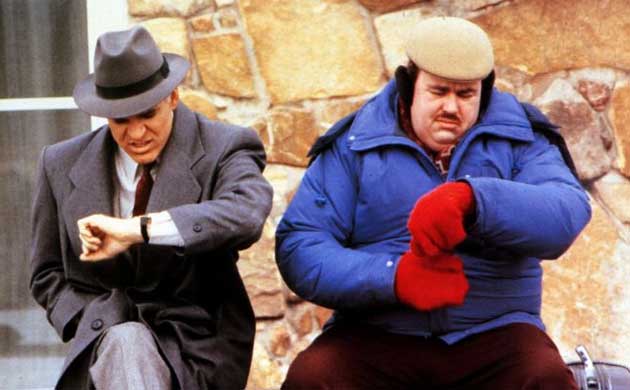
What do you get when you throw together two of the eighties biggest comedians, the writer of such hits as "The Breakfast Club" and "Sixteen Candles", and a cross-country road trip? Well, you get a laugh out loud, heartwarming, and very quotable movie called "Planes, Trains, and Automobiles".
This 1987 classic movie stars Steve Martin as Neil Page, an uptight and somewhat pessimistic executive who wants to be home for Thanksgiving on time; it also stars John Candy as Del Griffith, a kind-hearted and optimistic man who happens to meet Neil when they both vie for a taxi. From then on, the two continue to run into each other and due to bad weather and flight cancellations, they decide to embark on a journey to get Neil home in time for the holidays. On their way, they meet a woman who gave birth to a child that came out sideways, drive on the wrong side of the highway, and spoon each other in a motel. Each of these moments is not only memorable because of the absurdity, but because of John Hughes' dialogue that makes the somewhat unreal situation quite real. The characters feel like they could be people you know; Neil Page could be your uptight and conservative father with a short temper, while Del Griffith is your best friend's cool and understanding dad.
Hughes, who is the writer, director, and producer, incorporates the use of different camera movements and editing to emphasize the comedy and hold the audience's attention in each scene. For example, in the scene in which Neil and Del drive on the wrong side of the highway and are bypassed by two semi-trucks, quick shots are used to hold the audience's attention and to create a thrill in which the audience doesn't know what will happen next. We are shown cuts of Del and Neil, and within these quick cuts are different shots of the men dressed in costume, such as Del dressed as the devil. Another use of a shot for comedic response is when Del and Neil decide to shack up together and have to spend a night in the same bed. The camera pans starting from Del's body and makes its way to Neil, who is spooning with Del. It is truly hilarious and this is helped by the fact that it is filmed with just the right camera movement.
"Planes, Trains and Automobiles" at first glance might seem just like an eighties version of "Superbad" or anything that Will Ferrell makes nowadays. But this movie is mainly about the relationship of Del and Neil, two unlikely friends who bond together and help each other in unexpected ways. John Hughes does a magnificent job of creating funny situations and subtly incorporation the message that friends are what make the hard moments in life tolerable.
The characters seem to grow throughout the movie, and truly learn about what it means to be a true friend. I won't give away the ending, but I will say that it made me smile and my emotions were heightened by the eighties synthetic pop in the background- probably the only thing dating this otherwise timeless film.

Friday, February 22, 2008

BE KIND REWIND


So here is what I decided, I think I am going to try to blog everytime I see a movie. That might work out, or it may not, but for right now, it's gonna work. Tonight I went to see "Be Kind Rewind" starring Jack Black, Mos Def, Danny Glover, and Mia Farrow. It was pretty much an all-star cast which was pretty exciting if I do say so myself. Frankly, I'm kind of over all of these new comers and siblings, i.e. Jamie Lynn Spears, Emma Roberts, numerous Disney Channel stars. I want real actors who are good at what they do. And tonight, I got what I wished for. "Be Kind Rewind" is about two guys (Black and Def) who take over an older man's (Glover)video rental shop while he is away inspecting the DVD competition. In the process, Black's character becomes magnetic and erases all of the movies on tape at the video store (which shares the same name as the movie's title). With no other tapes, the boys must remake twenty minute versions of classic films such as "Ghostbusters", "Driving Ms. Daisy", and "Boys N Da Hood". Suddenly, there is a cult following to their movies, and everyone in town becomes involved.
I thought this movie had some pretty hilarious parts, mainly thanks to Jack Black, who can pretty much say "mayonaise" and make me burst out in laughter. The characters were realistic and innovative, and I enjoyed the mixed race cast. The only problem that I had was that the film was only a little over an hour yet it felt like a few hours. Some scenes went on a little too long and since there wasn't humor in every part, it kind of felt like the filmmakers could have cut out some sequences. I would recommend to people over the age of fifteen. Younger kids will most likely lose interest after a bit, and they might not understand all of the references to the films. All in all, it was a cute, lighthearted film that made me laugh and respect the power movies have over us all.

Tuesday, February 5, 2008

Critique the Critic


Peter Hartlaub's review of the horror comedy Teeth has the makings of a great critique. It isn't too long (around 530 words) and it hooks the reader from the beginning. Hartlaub notes that this is an "independent film that chooses the vagina dentata myth as a main theme and rides it for all the severed genitalia it's worth". Oh my. Let's just say that he had me at "vagina dentata". I enjoy that he adds humor to his brief statement of what Teeth is about. Hartlaub seems to understand that everyone knows that "severed genitalia" always gets a laugh. I respect that Hartlaub can have a lighthearted tone when critiquing this movie, when some critics would proabably rip it apart and become offended with this movie's subject.

As the critique goes on, Hartlaub warns the reader about the gore of this movie, and I thank him for doing so.
"Teeth" is extremely funny, very clever and still packs some cover-your-face bloody thrills that top any "Saw" or "Hostel" movie.
I am always thankful when a critic tells me straight up that "yes, there will be blood" or anything else that might serve as traumatic. I also like how he acknowledges that though this is a bloody movie, it is also a hilarious dark comedy. He doesn't have one trait of the movie overshadow the other, and alltogether, it serves as wonderful bait to get the reader excited and intrigued.

I also enjoy that Hartlaub gives two sides to his critique, even though he liked it, there were some things that he didn't enjoy about it.
Unfortunately, the original concept loses its bloom quickly, even at a brief 88 minutes. Once the premise is laid out, there's not much to do except wait for the next victim, and the quasi-feminist themes are never really developed. Dawn (main character) will no doubt be seen as a heroic figure to many, but she doesn't explore her condition as much as she keeps falling into bad situations with bloody results. And too much of the last half of the movie is slow and overly predictable.
I think that is a good trait of a film critic when they can praise a film when it deserves praise, and they can also point out the flaws of a film when it is necessary.

I enjoyed reading Peter Hartlaub's critique of the upcoming film Teeth, and it has persuaded me to coax a few friends to go and watch a man-eating vagina.

SORRY FORGOT THE LINK!!!: http://www.sfgate.com/cgi-bin/article.cgi?f=/c/a/2008/01/25/DDL7UL0RM.DTL